

When choosing between a bag filter and a cartridge filter, the right solution depends on your specific filtration requirements. Factors such as flow rate, filtration precision, operating pressure, budget, and maintenance expectations all play a critical role.
Below is a comprehensive comparison to help you select the best industrial filtration system for your needs.
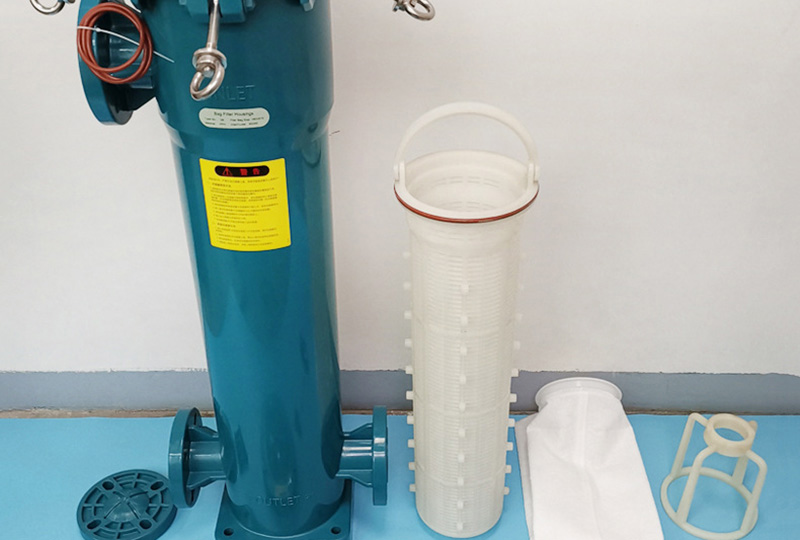
Bag Filter System
Advantages of Bag Filters
1. High Flow Rate Capacity
A single filter bag can handle 5–50 m³/h, making bag filtration systems ideal for large-volume industrial processes.
2. Lower Initial Investment
Bag filter housings are relatively affordable, and replacement filter bags typically cost only tens to hundreds of dollars, making them cost-effective for large-scale operations.
3. Easy Maintenance
Filter bag replacement is simple and fast. A single operator can complete the process within 5–10 minutes, minimizing downtime.
4. Large Filtration Area
Each bag provides a filtration surface area of 0.5–2 m², offering strong dirt-holding capacity and longer service intervals in high-solids environments.
5. Excellent Corrosion Resistance
Available in materials such as stainless steel, polypropylene (PP), and other corrosion-resistant plastics, bag filters perform well in acidic and alkaline environments.
Disadvantages of Bag Filters
-
Limited Filtration Precision: Typically ranges from 1–100 microns, with difficulty achieving stable filtration below 1 micron.
-
Lower Pressure Resistance: Operating pressure usually does not exceed 0.3 MPa.
-
Less Uniform Filtration Structure: Fiber distribution in filter bags may allow particle bypass under certain conditions.
Typical Applications
-
Chemical raw material pre-filtration
-
Food processing pre-treatment
-
High-flow, medium-to-low precision filtration
Cartridge Filter System
Advantages of Cartridge Filters
1. High Filtration Accuracy
Cartridge filters offer precision from 0.1–100 microns, with high-performance models reaching 0.01 micron filtration, ideal for fine and ultra-fine filtration.
2. Higher Pressure Resistance
Designed for working pressures of 0.6–0.8 MPa, suitable for high-pressure industrial systems.
3. Stable and Consistent Filtration Performance
Uniform pore size distribution ensures reliable and repeatable filtration efficiency.
4. Compact and Scalable Design
Flow capacity can be increased by installing multiple cartridges (e.g., 19-round or 37-round cartridge housings), allowing flexible expansion.
5. Wide Material Options
Available in polypropylene, polyester, nylon, fiberglass, and sintered stainless steel, supporting a wide range of industrial fluids.
Disadvantages of Cartridge Filters
-
Lower Flow per Cartridge: Each cartridge typically handles 0.5–5 m³/h; higher flow requires multiple cartridges in parallel.
-
More Complex Replacement Process: Multi-cartridge systems require opening the housing and removing several elements, increasing maintenance time.
-
Higher Operating Cost: Cartridge elements are more expensive, potentially raising long-term replacement costs.
Typical Applications
-
Semiconductor ultra-pure water systems
-
Pharmaceutical-grade water filtration
-
Food and beverage production
-
Lithium battery electrolyte filtration
-
Fine chemical processing
Bag Filter vs. Cartridge Filter: How to Choose?
| Selection Criteria | Choose Bag Filter | Choose Cartridge Filter |
|---|---|---|
| Filtration Precision | Above 1 micron | Below 0.1 micron |
| Flow Rate | High flow (>10 m³/h) | Medium to low flow (expandable with multiple cartridges) |
| Operating Pressure | Low pressure (<0.3 MPa) | High pressure (0.6–0.8 MPa) |
| Initial Investment | Budget-sensitive projects | High-precision projects with adequate budget |
| Maintenance Convenience | Fast replacement, minimal downtime | Accepts more complex maintenance |
| Fluid Characteristics | High turbidity, acidic or alkaline fluids | High-purity, low particle concentration fluids |
Combined Filtration System: The Best of Both Worlds
In many industrial filtration systems, a dual-stage filtration setup is used:
-
Bag filter as pre-filtration to remove large particles and reduce contaminant load.
-
Cartridge filter as fine filtration to achieve final precision requirements.
This configuration improves overall filtration efficiency, extends cartridge lifespan, and reduces operating costs.
Final Recommendation
-
Choose a bag filter system if your priority is high flow rate, lower cost, and easier maintenance.
-
Choose a cartridge filter system if your application demands high precision, stable performance, and higher pressure tolerance.
-
For demanding industrial processes, consider a bag + cartridge combination system for optimal performance and cost efficiency.